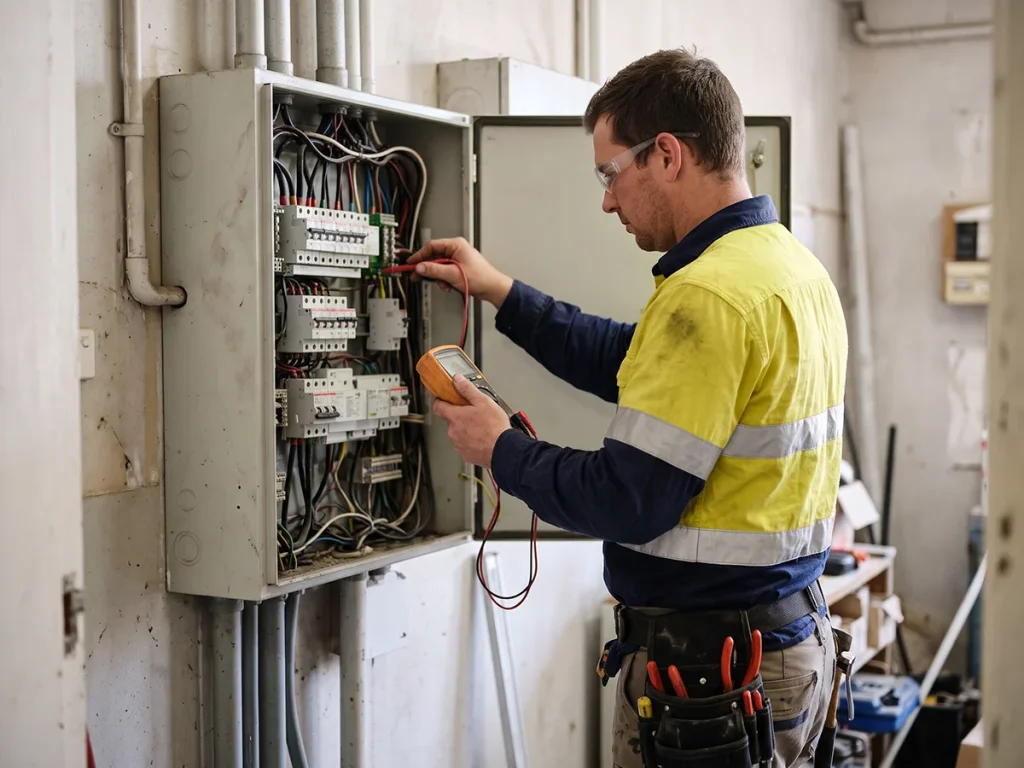
An electrician salary in Australia is one of the strongest in the trades. Being an electrician isn’t a restricted profession either, as there’s room to specialise in residential, maintenance, industrial, or construction roles.
This guide covers what electricians earn at every stage, from first-year apprentice pay to qualified wages, plus how the trade compares with others and which industries pay the most.
What is the Average Electrician Salary in Australia?
The typical full-time electrician earns $2,191 a week before tax, according to Australian Bureau of Statistics (ABS) data from May 2025, published by Jobs and Skills Australia (JSA). That works out to roughly $113,900 a year.
Because it’s a median, half of electricians earn more, and half earn less, which makes it a steady electrician salary benchmark in Australia.
How Does an Electrician Salary Compare to Other Trades?
The table sets the typical full-time electrician against plumbers, carpenters and joiners, and motor mechanics. For more on the best-paid trades, see our guide to the top-paying trades in Australia.
| Electricians | All occupations | Plumbers | Carpenters and joiners | Motor mechanics | |
|---|---|---|---|---|---|
| Median weekly full-time pay | $2,191 | $1,852 | $1,990 | $1,760 | $1,622 |
| Median hourly pay | $55 | $47 | $47 | $45 | $40 |
| Average full-time hours a week | 45 | 44 | 44 | 43 | 44 |
| Share working full-time | 94% | 69% | 93% | 89% | 91% |
Electricians come out ahead of all three trades on both pay measures, by $201 a week over plumbers, $431 over carpenters and joiners, and $569 over motor mechanics. They also work one to two more hours a week. All figures come from JSA’s occupation profiles (ABS data, May 2025).
How Much Does an Apprentice Electrician Earn?
Electrician apprentice pay starts lower, and it rises every year. Fair Work’s pay guide for the Electrical, Electronic and Communications Contracting Award sets the weekly minimums below for apprentices. An award is the legal document that sets minimum pay for an industry, and employers can always pay more.
| Year | Did not complete Year 12 | Completed Year 12 |
|---|---|---|
| 1st year | $622.72 | $682.76 |
| 2nd year | $742.79 | $802.84 |
| 3rd year | $862.87 | $862.87 |
| 4th year | $1,006.97 | $1,006.97 |
Your school education only changes the first two years. Finishing Year 12 lifts those rates, and from third year the two columns match.
Adult electrical apprentices get higher minimums under the same pay guide. First year is $982.95 a week ($25.87 an hour), and the second, third, and fourth years are $1,098.29 a week ($28.90 an hour).
In Queensland, the state’s Free Apprenticeships for Under 25s initiative covers course fees for eligible electrotechnology apprentices under 25, though related costs may apply.
What Do Qualified Electricians Earn Under the Award?
As a licensed electrician who has passed their Capstone exam, Fair Work’s pay guide from 1 July 2026 places you at electrical worker grade 5. The minimum is $1,223.11 a week, or $32.19 an hour, and that rate includes industry, tool, and electrician’s licence allowances. Over a year, that’s about $63,600 before overtime.
The award runs up to electrical worker grade 10, which pays $1,519.01 a week ($39.97 an hour) with the licence allowance. Higher grades pay more, so qualified electricians have room to move up.
Why is the ABS median so far above the minimum? The median full-time electrician earns about $968 a week more than the grade 5 award rate.
Overtime and penalty rates, which are extra pay for work outside ordinary hours, account for part of it. Under the same pay guide, the first 2 hours of overtime pay $48.29 an hour, rising to $64.38 after that.
Longer hours add to the gap, since electricians average 45 hours a week. Above-award compensation and the industry you work in complete the picture.
Which Electrician Jobs Pay the Most?
SEEK’s salary insights for October 2026 rank industries by the highest average advertised salary for electricians. These are full-time salary ranges that employers disclosed on SEEK job ads, and some include superannuation and other benefits while others don’t. Many employers list a range, so the table shows the average salary advertised in each industry, not what every job pays.
| Industry | Average advertised salary | Openings at time of check |
|---|---|---|
| Mining, Resources & Energy | $131,376 | 899 |
| Construction | $94,807 | 368 |
| Engineering | $90,572 | 953 |
| Trades & Services | $86,688 | 4,885 |
| Manufacturing, Transport & Logistics | $86,560 | 214 |
| Government & Defence | $74,652 | 87 |
Mining, Resources & Energy tops SEEK’s October 2026 list at $131,376, well above the ABS median, which shows how much your industry can matter. Trades & Services has the most openings, at 4,885, and Government & Defence sits lowest at $74,652. Read the table as a spread of advertised pay, with the award minimums as the floor.
Is Becoming an Electrician a Good Career Move?
Employment numbers are the best guide to how a trade career is tracking. JSA’s profile shows 197,300 people employed as electricians, with annual employment growth of 7,200 (ABS Labour Force Survey, 2025 four-quarter average), a sign of steady demand. The median age is 33, compared with 39 across all occupations.
Queensland holds the second-largest percentage of the country’s electricians, at 24.0%, behind New South Wales at 29.9% (Labour Force Survey, February 2026).
Qualifying leads to a career as a licensed electrician, with room for specialisation in the maintenance, industrial, and construction electrician roles we name. Day-to-day tasks draw on testing, fault finding, repairing, and maintenance, with electrical safety essential throughout.
That combination of steady full-time work and a choice of roles is a big part of the earning potential. A new apprentice starts on the award minimum, then moves through the grades and into the industries in the table above.
Electrician Salary Australia FAQs
Do electricians earn more in Western Australia?
The national sources used here don’t rank states by electrician pay, so there’s no reliable answer to that yet. Western Australia holds 14.0% of the country’s electricians (Labour Force Survey, February 2026). SEEK’s October 2026 ads put Mining, Resources & Energy on top at $131,376, so browse local job ads to see what companies in your location offer.
Do electricians get paid more for weekend work?
Sunday work does pay more. Under Fair Work’s pay guide from 1 July 2026, a grade 5 electrician earns $64.38 an hour on a Sunday, against $32.19 for ordinary hours. Public holidays pay $80.48 an hour.
How long does it take to become an electrician?
Our UEE30820 electrical apprenticeship has a nominal term of 48 months, and criteria apply. Across those four years, you do paid work as an apprentice electrician while you train.
Is 25 too old to become an electrician apprentice?
Our electrical apprenticeship page says you can apply at any age, so 25 and over is not too late. You’ll need a full-time or part-time job that gives you workplace access. Adult apprentice minimums under Fair Work’s pay guide start at $982.95 a week in the first year.
Start Earning as an Electrician With Major Training
Major Training, a Queensland registered training organisation (RTO), delivers electrical apprenticeships and can help you plan your first step.
We work with apprentices across Queensland and northern NSW, can train at your workplace, and tailor a training plan to the work your employer does. Its advisors check funding as part of that process, so you know what to expect before you commit. Major’s electrical apprenticeship is the UEE30820 Certificate III in Electrotechnology Electrician, and no formal entry requirements apply.
Call Major Training on 1300 790 822 to talk through your electrical apprenticeship options.

Thinking About an Electrical Apprenticeship?
We deliver the UEE30820 Certificate III in Electrotechnology Electrician as an electrical apprenticeship, with paid work throughout. Our advisors check funding and build a training plan with your employer. Tell us where you’re at, and an advisor will point you to the right next step.