Being a builder means you’re the structural mastermind holding a chaotic circus together. You could find yourself chasing delayed concrete trucks or dealing with hazards or filling out forms, but mostly you’ll be doing manual labour and working with materials and power tools.
All builders in Australia need the right licences, such as the White Card (more on that later). The usual pathway involves recognised training, relevant industry experience, and the right builder’s licence or registration for where you plan to work.
This guide shows you the steps you need to become a builder in Australia.
What Does a Builder Do?
A builder is the person trying to keep the entire construction project from turning into a blame game.
You might be coordinating trades in the morning, checking plans before lunch, chasing a material delivery in the afternoon, and dealing with a client who has just discovered they have one more small change to make.
Builders can work across residential homes, renovations, extensions, commercial buildings, and other building and construction projects.
Depending on the role, the job can involve:
- Supervising building work and subcontractors
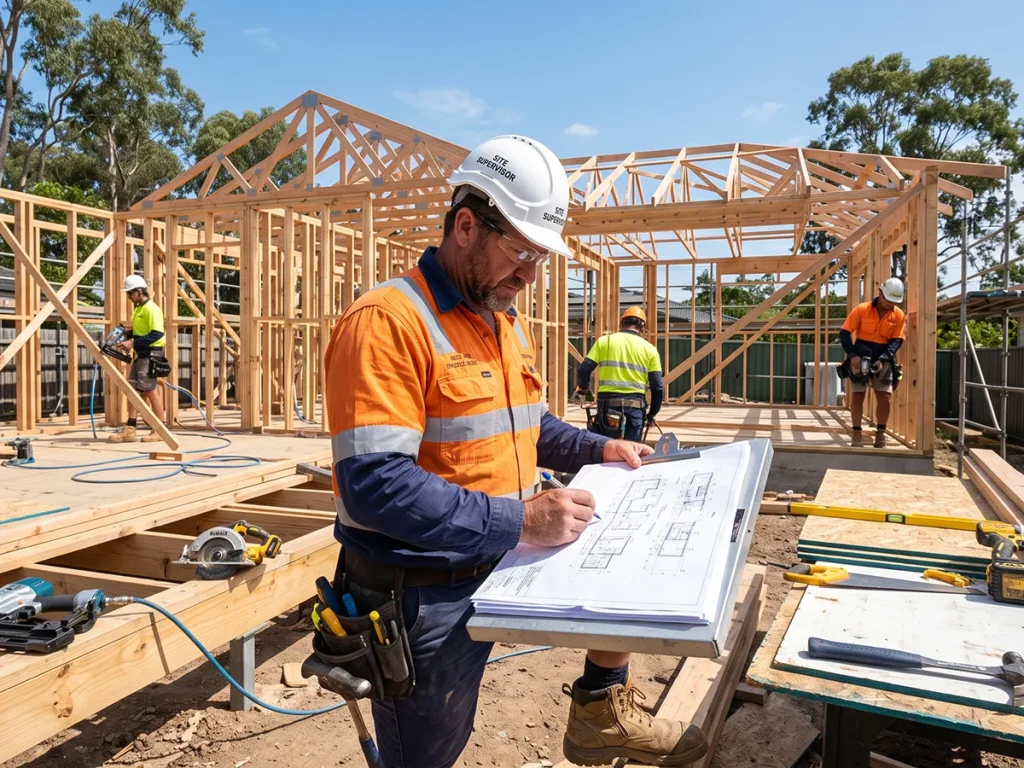
- Reading and interpreting plans and specifications
- Keeping the construction process moving from one stage to the next
- Organising materials and labour
- Coordinating trades and building services
- Managing project timelines and costs
- Checking work against plans and building codes
- Monitoring the work from foundation through to completion
- Communicating with clients, suppliers and authorities
- Managing site safety and legal responsibilities
You have to master the entire mechanical lifecycle, because a commercial build isn’t just “throw some timber together and cross your fingers.” You’re coordinating what happens across the whole project — from site surveys and soil tests through to concrete foundations and structural framing. Plumbing services, interior finishes, council inspections and final occupancy approvals all need to line up before the job is finished.
A top-tier builder doesn’t necessarily have to swing every single hammer themselves. You need to know what needs doing, who’s responsible for it and when it needs to be finished. You also need to know what happens if the work isn’t done properly.
And if the management side of construction sounds like your kind of headache, our guide on How to Become a Construction Manager is worth a look.
Steps to Become a Builder in Australia
There is no magic national checklist. Licensing is a state-by-state minefield. What flies in Queensland will get you fined in WA.
Here’s the basic path from working on the tools to taking on builder responsibilities:
1. Stack Your Real-World Construction Experience
You can’t run a site from a textbook. Most elite builders start hands-on as qualified carpenters, bricklayers, or formworkers. On the tools, you learn how trades clash, how materials misbehave, and why a five-minute chat with a subbie magically turns into a three-hour screaming match over variation costs.
2. Conquer the Certificate IV Qualification
Ready to drop the tool belt before your body breaks? You need proper paper. The absolute baseline is the Certificate IV in Building and Construction (CPC40120). The course can take around 6 to 24 months, depending on the training pathway. You must smash exactly 19 units of competency—comprising 11 core modules and 8 electives tailored strictly to your state’s licensing guidelines.
3. Log Your Supervised Years
A classroom certificate is great, but proving you won’t cave in a roof truss is another story. State boards mandate 2 to 4 years of supervised, hands-on industry experience before you can apply for an independent licence.
Stop throwing messy receipts into your truck’s glovebox. File your site diaries and contracts properly. The regulator will audit your paper trail, and future-you will be extremely grateful that present-you didn’t throw everything into a folder called “building stuff” and forget about it.
4. Decode Your Local State Licensing Framework
This is where you need to stop assuming that what applies to your mate in Queensland automatically applies to you in WA.
Australia does not have one national builder’s licence. Each state and territory has its own licensing or registration framework, including requirements around qualifications, experience, applications, and other suitability criteria.
Regulators like the Queensland Building and Construction Commission (QBCC) or the Victorian Building Authority (VBA) run completely different setups. The requirements can include financial checks, technical interviews, and insurance requirements, depending on the state. Know your local low-rise limits before you apply.
5. Lodge Your Government Application
Once you’ve completed your training, gained the required experience, and sorted your financial requirements, you can submit your application. Get your paperwork in order and make sure you’ve met the requirements before applying. Don’t be a cowboy who builds first and asks permission later. That is a stupid, fast, and phenomenally expensive way to face a judge.
Builder Qualifications & Training
This isn’t a soft course where you memorise basic building jargon, collect a piece of paper, and suddenly everyone calls you the boss. The coursework drills into the high-stakes, technical architecture of modern construction—the exact logic you depend on when managing structural blueprints, building codes, and material schedules.
To graduate, you must conquer exactly 19 units of competency, which is legally split into 11 mandatory core units and 8 technical elective units. To unlock the explicit occupational outcome of a registered builder, you must complete all foundational Group A electives, alongside up to two selections from Group B or the general training package pool.
The units cover areas such as:
- Applying structural principles to residential and low-rise commercial projects.
- Selecting, ordering, and managing high-volume material timelines.
- Conducting detailed on-site building suitability assessments and soil classifications.
- Managing workplace safety compliance, risk analysis frameworks, and site inductions.
- Administering legal construction contracts, processing variation orders, and estimating project costs.
Regulatory boards enforce strict prerequisite unit requirements. These gateways explicitly cover applying building codes and standards to Class 1 and 10 residential structures, alongside Class 2 to 9 Type C commercial builds.
Completing the nationally recognised pathway through an approved RTO gives you the training needed to meet the relevant requirements. It can help you avoid costly compliance issues and the sort of structural mistakes that can cause serious problems on site.
How Long Does It Take to Become a Builder?
Here is the annoying answer that nobody wants to hear. There is absolutely no single, magic timeline stamped on the side of a builder’s hard hat.
Nailing down the Certificate IV in Building & Construction is merely one piece of a highly complex structural puzzle, with the actual course duration running anywhere between 6 and 24 months, depending on your study mode.
Your years on the tools and any prior vocational learning can make the process quicker. But you’ll still need to jump through your state regulator’s licensing or registration hoops before you can legally trade as a builder.
If you have already spent a decade busting your back as a qualified carpenter, you can drastically accelerate the process by fast-tracking modules through a formal Recognition of Prior Learning (RPL) assessment.
Either way, state licensing boards strictly mandate that you must accumulate 2 to 4 years of supervised, hands-on industry experience before you can even think about applying for an independent license.
If you are starting completely from scratch with zero construction background, you are looking at a long, rugged road.
Builder Salary and Market Realities in Australia
Let’s get straight to the question that everyone actually wants answered: What is the money looking like when you are running the show?
Here is some straight-talking truth from the site office: we are not going to pull a suspiciously clean, massive six-figure salary out of thin air just to make you feel warm and fuzzy. Official federal datasets hosted by Jobs and Skills Australia do not split independent contract profits into a neat, generic “builder salary” box.
Instead, government data tracks the broader construction manager occupation, which has median full-time earnings of $3,751 per week. The data also shows median earnings of $1,827 per week ($40 per hour) for building and plumbing labourers across a workforce of around 70,000.
Do not look at baseline labourer metrics and assume that is what a licensed business owner takes home at the end of a project.
Builder earnings can vary wildly. Your location, project size, subcontractor margins, and whether you’re on a salary or running your own building business can all change the number on the payslip.
Licences & Tickets You’ll Need
Here’s where things get very Australian: the building industry is regulated, but the exact rules depend on where you’re working and what you’re doing.
You may also need additional construction tickets depending on your actual job responsibilities and the sites you’re working on.
White Card
If you’re working on a construction site, general construction induction training is a basic requirement.
Major Training’s Construction Induction Card (White Card) covers the knowledge needed to recognise common site hazards, follow safety procedures, and work responsibly around active construction work.
It won’t turn you into a builder overnight. It does, however, mean you aren’t wandering onto site completely clueless about the hazards around you.
Working Safely at Heights
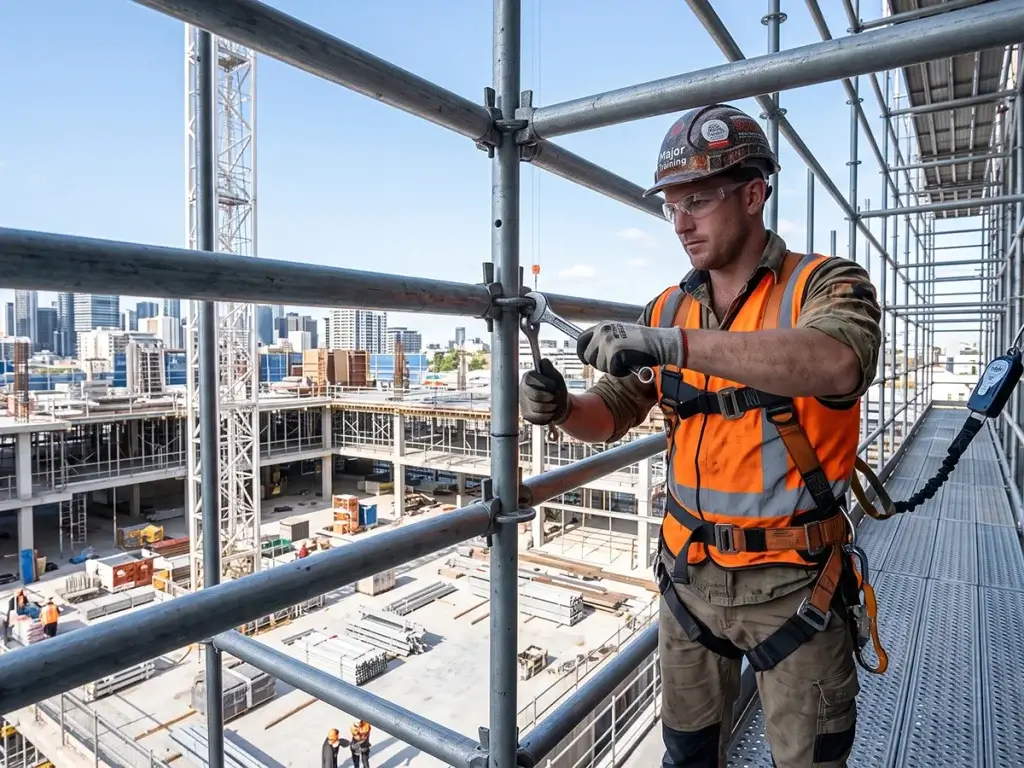
Construction has a habit of putting things several metres above the ground and then expecting someone to go up there. If your role involves work at height, Working Safely at Heights Training provides relevant safety training for those situations.
Because “I’ve got decent balance” isn’t exactly the qualification regulators are looking for.
Basic Scaffolding
If your work involves erecting, altering, or dismantling scaffolding, you may need the relevant high-risk work licence. Major Training offers Licence to Erect, Alter and Dismantle Scaffolding – Basic Level for the relevant training pathway.
The important bit is to match the ticket to the work you’re actually performing and check the requirements that apply in your state or territory.
Building doesn’t stop at one job title.
If you’re interested in the lifting and coordination side of construction, our guide on What Is Rigging in Construction? explains where rigging fits into the wider construction workplace.
Ready to Start Your Building Career?
You’ve now got the broad roadmap. You’ll need relevant construction experience, the right qualification and the licensing or registration required in your state or territory.
The next step is turning the plan into something slightly more useful than a tab you’ve had open for six months.
Call Major Training on 1300 790 822 to discuss your options.
Frequently Asked Questions
What Qualifications Do I Need To Be A Builder In Australia?
A relevant building qualification can help you build the knowledge needed to work in the construction industry. CPC40120 Certificate IV in Building and Construction is one pathway, although the exact qualification and experience requirements for builder licensing or registration depend on your state or territory.
How Much Money Does A Builder Make In Australia?
Jobs and Skills Australia data does not provide a specific salary figure for licensed builders. It reports median full-time weekly earnings of $1,827 for the broader Building and Plumbing Labourers occupation, so this should not be treated as a builder’s salary.
Can I Build A House For $300,000 In Australia?
Whether a house can be built for $300,000 depends on factors such as location, land costs, design, materials, labour, site conditions, permits, and the scope of the project. There is no single national construction cost that applies to every building project.
How Long Does It Take To Get A Builder’s Licence In Australia?
There is no single national timeframe. Licensing and registration requirements vary between states and territories and may depend on your qualifications, relevant industry experience, documentation, and the type of building work you intend to undertake.
Do I Need A Builder’s Licence In Australia?
Requirements vary by state and territory and by the type and value of building work being carried out. Australia does not have one national builder’s licence, so you need to check the requirements of the relevant local regulator.
What Does A Building Supervisor Do?
A building supervisor keeps construction projects on track, coordinating trades, checking work, managing labour and material schedules, and monitoring site progress. On low-rise building projects, they may also handle project management, site supervision, and ensure contractors follow strict safety regulations and building code requirements.
What Skills Does A Successful Builder Need?
A successful builder needs practical experience and strong project management skills. They also need to understand plans, structural requirements, and building codes while keeping up with changes in the industry.

Ready to Start Your Building Career?
Turn your site experience into a Certificate IV in Building and Construction. Call Major Training on 1300 790 822 to discuss your options.