Stacking heavy steel modular frames hundreds of metres in the air is a high-risk but thrilling trade that forms the literal backbone of every major building project in the country. As a scaffolder, you are the person ensuring other trades can stand in the sky safely without plunging to the dirt.
But you can’t just slap a couple of steel pipes together and call it a day. The law is brutally clear: if a platform allows a worker to fall over 4 metres, you cannot touch it without a legal High Risk Work Licence.
If you want to become a scaffolder in Australia, you’ll need the right scaffolding training, practical skills, and the appropriate High Risk Work Licence. Here’s how you get there.
What Does a Scaffolder Do?
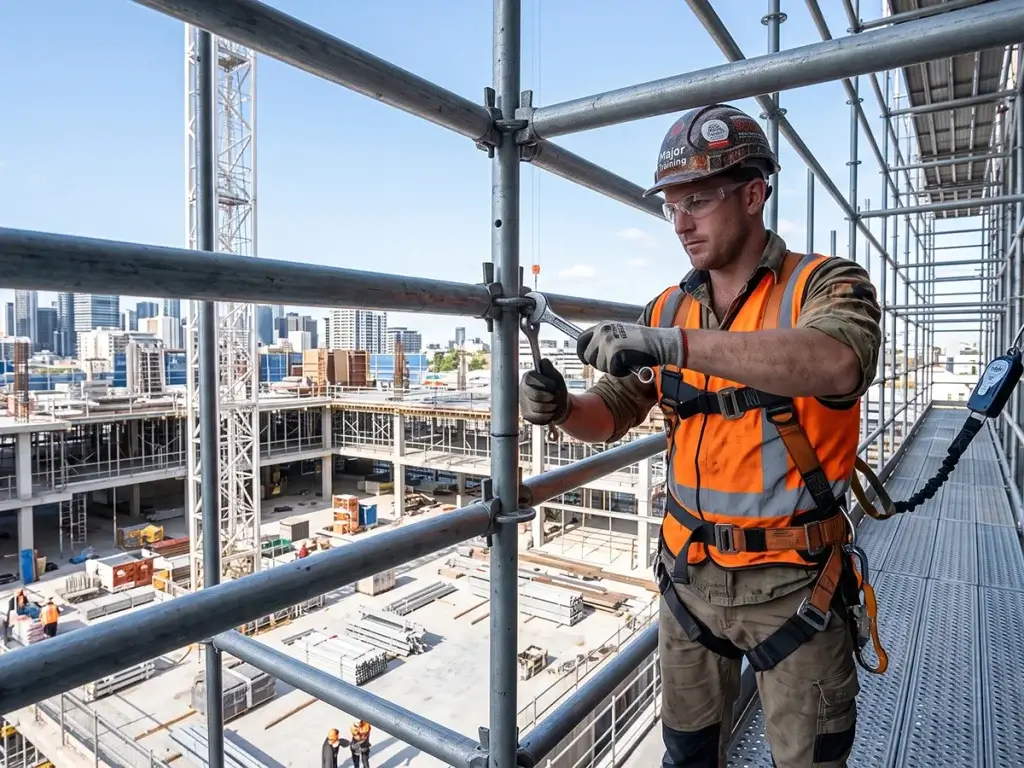
You aren’t just a glorified pack mule carrying heavy steel pipes from A to B. A qualified scaffolder is the structural gatekeeper building the temporary platforms that let every other trade do their job in the sky without turning the site into a horrific workplace incident.
You’re managing immense physical weight. One loose wedge or a poorly placed base plate can trigger a catastrophic structural collapse in a fraction of a second.
Inside the harness, your daily duties mean executing sharp, precise movements under pressure:
- Erecting, altering, and dismantling complex structural scaffolding arrays.
- Setting up high-load modular and prefabricated scaffolds.
- Manipulating heavy ropes, gin wheels, and cantilevered materials hoists up to 500 kg.
- Installing structural safety nets, static lines, and industrial bracket scaffolds.
- Checking ground conditions, auditing soil stability, and verifying load-bearing foundations.
You’ll spend much of your shift climbing and connecting heavy components while working around active crews. It’s physical work, and you need to stay aware of what’s happening around you. Ripping through a high-rise build efficiently means treating your equipment with absolute respect.
Before the scaffold goes up, you’ll inspect the components, follow the relevant SWMS, and make sure the required handover paperwork and site tags are in order. You are also entirely responsible for communicating clearly with your team, because shouting across a busy construction zone is definitely not a recognised safety procedure.
If you’re curious about the equipment and lifting side of the construction industry, our guide on what rigging is in construction is worth a look too.
Steps to Become a Scaffolder in Australia
There is no magic button to suddenly become a scaffolder. Entering this high-risk trade requires a strict mix of safety induction, accredited institutional blocks, and rigorous practical testing.
Here is the exact, fast-tracked roadmap to earn your legal trade stripes:
1. Secure Your White Card Baseline
You cannot legally step onto a muddy construction site or enrol in high-risk training without a valid entry ticket. Completing your Construction Induction Card / White Card (CPCWHS1001) is an absolute legal prerequisite, providing the baseline hazard identification skills needed to survive on the tools.
2. Conquer the Basic Scaffolding Course
Ready to drop the manual labour grunt work? You need proper credentials. Your gateway is the Basic Scaffolding Course (CPCCLSF2001). Delivered as a tight, intensive 4- to 5-day face-to-face block, this RTO course breaks down structural load geometry, engineering calculations, and modular layout planning.
3. Smash Your Practical Assessment
This is definitely not a lazy classroom pathway. To secure your statement of attainment, you’ll need to demonstrate that you can safely plan and carry out the work involved in erecting, altering and dismantling scaffolding. The assessment also covers equipment such as ropes, gin wheels, static lines and cantilevered materials hoists up to 500 kg.
4. Lodge Your Official High Risk Work Licence
Training makes you competent; licensing makes it legal. Once your practical exam is signed off, you have exactly 60 days to submit your application to your state safety regulator (like Workplace Health and Safety Queensland). They print your physical photo card, which remains legally valid for five years before a mandatory renewal is required.
5. Build Experience and Progress Your Tickets
Earning your basic ticket gets you inside the gate, but you can build on it as you gain experience. The next step is usually moving into Intermediate and Advanced scaffolding, which lets you take on more complex work.
Scaffolding Syllabus & Course Logistics
This is where the hard hat goes on, and the theory meets the steel. That means this isn’t a soft course where you just learn how to slot steel bars together like a giant backyard playground set. Formal RTO training covers the engineering principles and structural physics behind scaffolding. You’ll also learn how to manage the safety risks involved when working with heavy structures above active worksites.
The basic syllabus systematically breaks down into critical operational sectors:
- Planning the Task: You’ll learn how to read task instructions and interpret Safe Work Method Statements (SWMS). You’ll also identify site hazards, set up risk controls and work out scaffold load limits.
- Inspecting Equipment: Before anything goes up, you’ll check modular components, fall protection gear, specialised PPE and communication equipment for defects or damage.
- Preparing Ground Conditions: You’ll assess soil stability and surface compaction before setting up sole boards. The base needs to be level and stable before you start building upwards.
- Erecting and Dismantling: You’ll learn how to safely put up and dismantle modular scaffolds. The training also covers cantilevered material hoists up to 500 kg, ropes, gin wheels, safety nets, static lines and bracket scaffolds.
- Finishing the Build: Once the scaffold is complete, you’ll carry out the final checks, attach the required scaffold tags and complete the handover paperwork. Any damaged or defective equipment needs to be isolated.
Basically, this is the exact part of your high-risk career where “she’ll be right, mate” officially stops being an acceptable construction methodology. You’re working around changing conditions, including strong winds, live electrical assets, falling-object risks and mobile plant.
Completing this nationally recognised pathway through an approved RTO is your only legitimate legal shield against catastrophic structural failures, massive compliance fines, and critical site hazards on the tools.
Scaffolder Salaries and Market Realities
Let’s talk money. When it comes to your absolute financial trajectory, high-risk structural access is exceptionally lucrative. Because scaffolders carry extreme physical safety responsibilities, premium tier-one builders and mining entities pay top dollar to secure elite talent.
Let’s look at the hard data. Official federal Jobs and Skills Australia workforce metrics show that there are currently 8,400 scaffolders actively employed across the country, with a dominant 80.4% of the workforce locking in stable, full-time hours.
Due to continuous project delivery timelines, full-time operators maintain an intense national industry average of 45 to 50 hours per week.
According to verified national market tracking data on the SEEK Scaffolder Portal, the standard average annual salary range for a qualified scaffolder sits comfortably between $80,000 and $100,000 per year. Green yard hands and entry-level workers generally start on a lower award rate while they build up supervised site hours. As they tick off practical benchmarks and gain advanced endorsements, their wages can increase.
The real wealth is unlocked out in the field. Experienced scaffolders working on complex industrial or high-rise projects can earn more, particularly where the work involves specialised equipment or remote FIFO sites.
Treat these broad baseline figures as a tactical guide rather than an absolute promise printed on the side of your harness. Your final paycheck varies considerably based on your field experience, your accumulated high-risk licence classes, your choice of industry, and your personal willingness to chase the overtime hours.
Crucial Safety Tickets and High-Risk Progressions to Boost Your Value
Let’s be realistic: holding a basic ticket is a solid start, but one machine doesn’t have to be the end of the story. Scaffolding falls under strict federal high-risk work requirements, meaning your core ticket is only one tool in the toolbox. If you want to take on more complex scaffolding work, you can progress from Basic to Intermediate and then Advanced training as you meet the relevant requirements.
1. Intermediate Scaffolding
Ready to step away from basic layouts? Once you build up your logbook hours, the Intermediate Scaffolding Ticket takes your career further. This structural upgrade legally qualifies you to handle more complex industrial setups, including traditional tube and coupler configurations, cantilevered crane platforms, barrow ramps, and multi-storey edge protection.
2. Advanced Scaffolding
This is where the real money is unlocked. Completing your heavy-construction Advanced Scaffolding Ticket turns you into an elite tier-one specialist. You will possess the accredited capability to manage highly complex suspended hanging scaffolds, structural rigging chains, custom fabric configurations, and high-rise cantilevered hoists.
👉 And don’t forget the White Card. To legally step past the gates of any active project site to build these structures, you also need White Card. It isn’t optional decoration for your wallet.
More height, more complexity, more responsibility. Want to see why proper rigging and scaffolding training matters on site? Check out our guide to rigging and scaffolding training for safety and efficiency.
Ready to Get Off the Ground?
Scaffolding isn’t a trade for someone who wants a quiet desk, a swivel chair, and a deeply personal relationship with spreadsheets.
It’s physical. It’s technical. And when you’re working several metres above the ground, getting the details wrong isn’t an option.
If you’re ready to start, take a look at Major’s Basic Scaffolding training and see where the qualification can take you.
Call Major on 1300 790 822 to discuss your training options.
Frequently Asked Questions
How Much Do Scaffolders Earn In Australia?
SEEK lists the average annual salary for scaffolder jobs in Australia at around $80,000–$100,000. Actual pay varies with experience, location, employer, and type of scaffolding work.
Is Scaffolding Hard Work?
Yes. Scaffolding is physically demanding and involves working at height while handling heavy components. You also need to follow detailed safety procedures and manage changing site conditions.
What Licence Do You Need To Be A Scaffolder In Australia?
Scaffolding work requires the relevant High Risk Work Licence class. You’ll need to complete the required training and competency assessment before going through the applicable licensing process. Completing the training unit alone does not automatically issue the licence.
Do Scaffolders Need A White Card?
Yes. General construction induction training is required for construction work, and the White Card unit CPCWHS1001 meets this requirement. It is also required as the induction baseline before assessment for the basic scaffolding unit.
Can I Progress Beyond Basic Scaffolding?
Yes. The scaffolding pathway includes Basic, Intermediate, and Advanced levels. As you progress, you can take on more specialised scaffolding, including different structures and systems, while developing the skills needed to erect, alter, and dismantle scaffolding safely.
What Safety Risks Do Scaffolders Need To Understand?
Scaffolders need to manage risks such as falls from height, falling objects, unstable ground, damaged equipment, electrical hazards, traffic, and adverse weather. Understanding these hazards and the right controls is essential for preventing serious incidents and workplace fatalities on construction sites.

Ready to Start Your Building Career?
Scaffolding isn’t a trade for someone who wants a quiet desk, a swivel chair, and a deeply personal relationship with spreadsheets.