If you like:
- Working with structural metal
- Using your hands to build real things
- Seeing a solid, finished product take shape from raw steel
Welding might be right up your alley
There is something deeply satisfying about pulling on a welding helmet, striking an arc, and watching raw sparks fly as you fuse heavy steel together. Professional welders form the literal backbone of heavy industry across the country, working seamlessly across major construction, commercial manufacturing, remote mining, engineering, and fabrication sectors.
On any given day, you could be joining and shaping metal for everything from massive structural steel building frames to heavy-duty earthmoving machinery.
So, how do you actually become a qualified welder in Australia? The usual route is an apprenticeship, where you work towards your Certificate III while building your skills on the job.
Let’s look at what you’ll learn, how long the training takes, what you can earn, and where welding can take you.
What Does a Welder Do?
In the real world of heavy engineering, a welder joins metal components using precise heat, targeted pressure, or a combination of specialised welding processes.
What you do day to day depends on your industry, the materials you’re working with, and the welding processes you’ve trained in.
Instead of being stuck at a single bench, your career could see you working with massive structural steel beams, heavy-duty mobile machinery, high-pressure pipes, intricate sheet metal, or customised fabricated components.
Furthermore, your workplace will shift based on your role, with some welders spending their time in clean workshops, while others work directly on active construction sites, busy manufacturing floors, remote mining operations, or massive industrial infrastructure projects.
Your day-to-day work can include:
- Reading drawings and blueprints before starting a job
- Measuring, marking, and preparing metal
- Cutting and shaping metal parts
- Setting up welding equipment
- Joining components using different welding processes
- Grinding, cleaning, and finishing completed welds
- Checking welds for quality, accuracy, and penetration
- Using hand tools and power tools safely
- Following workplace health and safety requirements
The type of welding you do can also change as your experience grows. You might start with general fabrication work and later move into structural steel, pressure welding, pipe welding, or other specialised areas.
Steps to Become a Welder in Australia
There isn’t a single route into every welding job, but an apprenticeship is the standard pathway for becoming a qualified welder.
1. Find a Welding Apprenticeship
Your apprenticeship starts with a formal training contract and a workplace where you can learn the trade properly.
Working as an apprentice means you are entering an intensive, fast-paced “earn while you learn” employment agreement.
Under the direct supervision of a qualified boilermaker or senior fabricator, you will spend your initial shifts learning how to configure heavy welding equipment, prepare diverse raw materials, read complex industrial drawings, and apply absolute zero-harm safety practices on the floor.
While some candidates choose to complete a brief pre-apprenticeship course to pick up baseline engineering and workshop skills, you must land a dedicated host employer before your official qualification hours can legally accumulate.
2. Start Your Certificate III
Once your employment framework is locked in, you will complete your mandatory institutional blocks through an approved registered training organisation.
If you happen to encounter out-of-date trade articles or legacy forum threads recommending the older MEM31922 packaging rules, pay close attention to the publication dates.
The legacy curriculum has been completely superseded by the modern MEM31925 framework. Regulatory authorities have mandated a strict final cut-off date: no apprentice training or formal assessments can legally continue under the old qualification past September 2, 2026.
3. Build Real-World Practical Welding Skills
You can study textbooks until your eyes bleed, but structural fabrication is a craft you learn by putting in the hours on the tools.
A large part of your 48-month nominal term will be spent on your feet, developing muscle memory under the watchful eye of a seasoned tradesperson.
As your technical block releases progress, you’ll learn to select the right shielding gases, adjust voltage parameters, set up your work area safely, and use different welding techniques.
Then comes the part where you start getting properly confident. Your skills will expand into thermal cutting, precise material fitting, mechanical alignment, and clean surface finishing.
4. Develop Your Welding Specialisation
As you progress, your training and workplace experience can take you towards different welding streams.
Common processes include:
- Manual Metal Arc Welding (MMAW)
- Gas Metal Arc Welding (GMAW)
- Gas Tungsten Arc Welding (GTAW)
- Flux Cored Arc Welding (FCAW)
You may also move into structural steel, fabrication, pipework, pressure welding or other specialist areas.
The qualification gives you a broad fabrication foundation, while your elective choices and workplace experience can help shape the type of welding work you move into.
5. Complete Your Qualification
Once you’ve successfully completed the required training and assessment, you’ll have a nationally recognised trade qualification.
From there, you can continue building experience, pursue additional certifications or move into more specialised welding roles.
Welder Qualifications & Training
Let’s cut straight to the chase. Becoming a qualified welder takes more than a steady hand and a willingness to work hard. You’ll need a nationally recognised qualification behind you, along with the practical experience that comes from training on the job.
The standard qualification is Certificate III in Engineering – Fabrication Trade (MEM31925). It covers the broader fabrication trade across areas such as welding, structural steel, sheet metal work, blacksmithing, and surface finishing.
Do not expect a simple checklist of subjects. The engineering training package operates on a strict, nationally regulated points-based packaging structure rather than a flat unit count. To complete the qualification, you need to meet the required 129 weighting points, including the core and elective requirements. This total is legally locked into 33 points from the mandatory core units, alongside a minimum of 96 points of technical elective units selected from approved industrial training groups.
It is a demanding framework, but it gives you total flexibility to shape your training plan around your employer’s specific workshop tasks. Over the multi-year duration of your course, this intensive structure sharpens your practical capabilities to an elite level.
For someone entering welding, the training develops practical skills such as:
- Reading drawings and blueprints
- Measuring and marking materials
- Preparing and fitting metal components
- Using welding equipment
- Applying different welding techniques
- Using hand tools and power tools
- Inspecting and finishing welds
- Following occupational health and safety requirements
The qualification has no formal national entry requirements, although individual employers or RTOs may have their own enrolment or selection processes.
If you’re looking for an apprenticeship-based training option, our Certificate III in Engineering – Fabrication Trade is available through training facilities at Gold Coast, Dinmore, Morayfield and Cairns.
How Long Does It Take to Become a Welder?
Four years might sound like a long time, but you aren’t spending those four years sitting in a classroom. A full-time engineering fabrication apprenticeship typically takes 48 months, or four years, in Queensland, and apprentices generally start with a 90-day probation period. That gives you and your employer some time to work out whether the arrangement is the right fit.
Most of those four years are spent doing the job, not just learning about it. You’ll work, train, and build practical experience alongside your formal training and assessment.
How quickly you move through the apprenticeship can depend on your training plan, the experience you pick up at work, and the type of welding work available to you. School-based and part-time arrangements can take longer.
If you’re trying to work out whether an apprenticeship or traineeship makes more sense for you, our Apprenticeship vs Traineeship: Complete Comparison guide breaks down the difference.
Welder Salary in Australia
Welding can pay well, but your first wage isn’t necessarily where the story ends. What you earn can change considerably with experience, location, industry, the type of welding you take on, and the certifications you add along the way.
Jobs and Skills Australia reports median full-time earnings of $1,688 per week for Structural Steel and Welding Trades Workers. Annualised, that’s roughly $87,800 before tax. It’s a median, not an average, so individual wages can land well above or below that figure.
Apprentices are on a different starting point. Their wages generally increase as they progress through their training and become more experienced on the tools.
For most welders, specialisation is where things can get interesting. A First Class Welder working in pressure welding, heavy industry, or mining can have higher earning potential than someone starting out in general workshop fabrication.
There’s also strong demand for welding skills across construction, manufacturing, engineering and mining, which creates a range of employment opportunities as you gain experience.
So if you’re looking at welding as an entry-level career, the starting salary is only part of the picture.
Job Outlook & Career Opportunities for Welders
Welders work across a wide range of industries, including construction, manufacturing, engineering, mining, automotive, shipbuilding and other industrial environments.
Jobs and Skills Australia classifies Welders (First Class) within the broader Structural Steel and Welding Trades Workers group. The occupation includes workers who fabricate and repair metal products using different welding techniques.
As your skills develop, you can move into different career paths. These might include:
- Structural steel welding
- Fabrication
- Pressure welding
- Pipe welding
- Mining and heavy industry
- Welding inspection
- Welding supervision
- Fabrication business ownership
Welding can also be a useful foundation for broader fabrication and boilermaking work. The current qualification itself covers a range of fabrication occupations, so your career doesn’t have to be limited to one type of welding.
What Skills Do Employers Look For?
Producing a clean weld is not the only part of the job. Employers also look for people who can:
- Measure and prepare materials accurately
- Read drawings and blueprints
- Use welding equipment correctly
- Work safely around heat, machinery and materials
- Follow workplace procedures
- Pay attention to detail
- Solve problems when a job doesn’t go to plan
- Work reliably as part of a team
Good hand-eye coordination helps, but so does patience. Welding often involves small adjustments that make a big difference to the finished result.
Licences & Tickets You’ll Need
The Certificate III in Engineering – Fabrication Trade (MEM31925) itself doesn’t have a national licensing, legislative, or certification requirement at the time of publication. However, some types of welding work and workplaces can have additional requirements, particularly where you’re working with high-risk equipment or specialised applications.
White Card
If your fabrication or structural modification duties require you to perform steel installations on an active construction site, you cannot legally step onto the dirt without a valid entry ticket.
This isn’t part of your welding qualification. It’s an additional requirement that can become relevant when your job involves construction work.
If that’s where you’re headed, you can find the training details for Major Training’s Construction Induction Card (White Card).
Working Safely at Heights
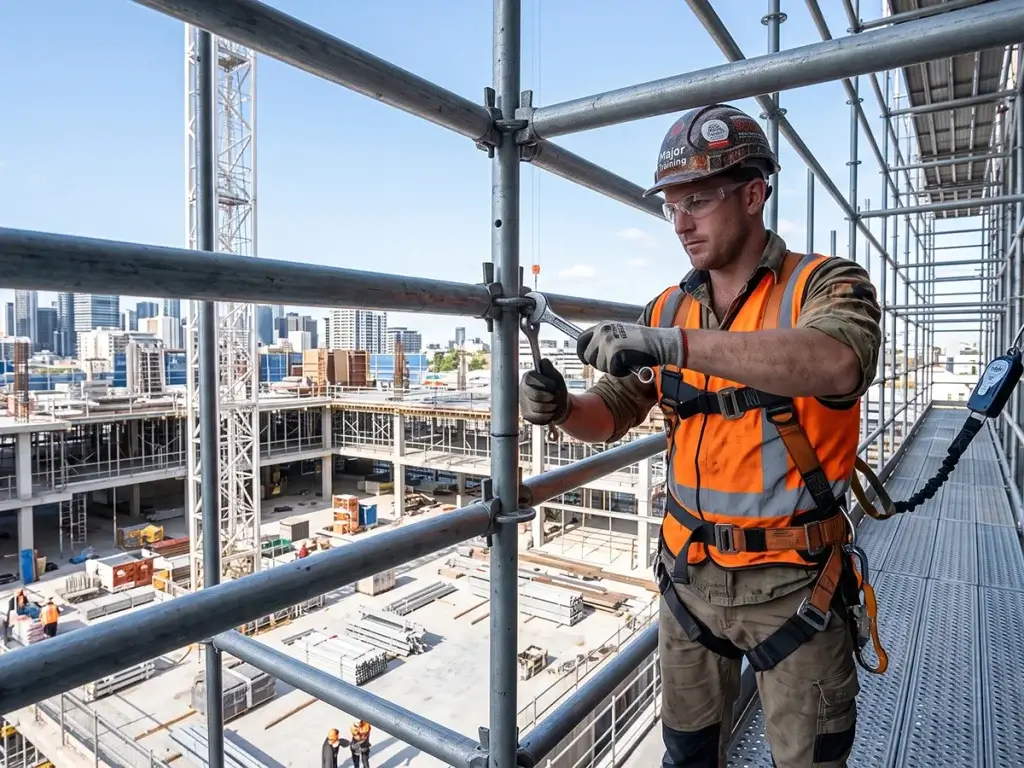
Welding doesn’t always happen with both feet safely on the ground. If you’ll be working from platforms, scaffolding or other elevated areas, additional height-safety training is an absolute site baseline.
Working Safely at Heights training covers how to identify hazards and use appropriate safety controls when working above ground level.
Looking for Working Safely at Heights training? You can check the course details to see what’s covered and where it’s delivered. Major Training lists delivery at its Gold Coast Training Facility and Morayfield/Caboolture locations.
First Aid & CPR
Operating structural tools, handling intense heat paths, managing extreme pressure vessels, and working near heavy machinery mean trade workshops are naturally high-risk environments. While a medical ticket is a separate addition to your engineering syllabus, having basic first aid qualifications is a prerequisite for moving into leading hand or workshop foreman roles.
Completing this specialised face-to-face short course gives you the exact practical knowledge needed to respond to emergency cardiac incidents, administer fracture care, and confidently manage emergency site situations until professional medical help arrives.
If you’d like to add first aid skills to your toolkit, you can find the details for Major Training’s Provide First Aid course here.
Welding Certifications for Specialist Work
Here’s some straight-talking advice from the workshop floor: completing your basic trade qualification gives you the foundation to weld professionally, but it doesn’t automatically qualify you for every type of high-integrity work. Structural infrastructure, pressure vessels, and heavy industrial projects can come with additional certification and compliance requirements.
AS 1796 and AS 2214 are examples of Australian standards associated with welder certification and supervision, while the Australian Welder Certification Register (AWCR) helps record and verify welder competencies.
Think of your Certificate III as the foundation, not an all-access pass. If you’re moving into specialised welding, check what the particular job and industry require before taking the next step.
Start Your Welding Apprenticeship
Ready to turn an interest in welding into a trade?
A welding apprenticeship gives you the chance to earn while you learn, combining workplace experience with formal training towards a nationally recognised fabrication qualification.
Major Training offers the Certificate III in Engineering – Fabrication Trade (MEM31925) across its Gold Coast, Dinmore, Morayfield and Cairns training facilities.
Want to explore the course? Check the Certificate III in Engineering – Fabrication Trade for course and training information.
Frequently Asked Questions
How Much Does A Welder Get Paid In Australia?
Pay varies by experience, location and specialisation. Jobs and Skills Australia reports median full-time earnings of $1,688 per week for Structural Steel and Welding Trades Workers, while specialist welding roles can pay considerably more.
Can You Make $100,000 As A Welder?
Yes, particularly in specialist areas such as pressure welding, mining, and heavy industrial work. However, $100,000 isn’t a standard starting salary. Your experience, certifications, industry, and work location all affect your earning potential.
Is 35 Too Old To Start Welding?
There’s generally no upper age limit for starting an apprenticeship. What matters is whether you’re eligible for the apprenticeship and prepared for the physical work, safety requirements, and practical training involved.
Can I Move To Australia As A Welder?
Welding-related occupations appear on Australia’s skilled occupation framework, but the exact pathway depends on your occupation, visa application and circumstances. Home Affairs currently lists occupations including Pressure Welder, Welder (First Class) and Fitter-Welder, with Trades Recognition Australia listed as the assessing authority for these occupations.
If you’re applying from overseas, you’ll need to check the current visa requirements and whether your specific occupation is eligible. A skills assessment may also be required.
Do I Need Year 10 Or Year 12 To Become A Welder In Australia?
You don’t need a specific Year 10 or Year 12 qualification to enter the current Certificate III in Engineering – Fabrication Trade (MEM31925). The national qualification has no formal entry requirements. However, basic literacy, numeracy and the ability to understand technical information are important because you’ll use measurements, calculations, drawings and workplace instructions throughout your training.
Can I Combine Welding And Boilermaking Training?
Yes. Welding and boilermaking can be combined within the broader Certificate III in Engineering – Fabrication Trade (MEM31925) pathway. Major Training currently delivers a Fabrication Trade – Boilermaking/Welding stream, allowing apprentices to build skills across both areas.
This can be useful if you want a broader fabrication skill set and don’t want to limit yourself to one type of welding work.
What is the Australian Welder Certification Register?
The Australian Welder Certification Register (AWCR) is a national register managed by Weld Australia. It provides a framework for qualifying and testing welders against standards, including AS/NZS ISO 9606-1. Registered welders can have their qualifications, certifications, and work history recorded in a verifiable format for employers.
Can Becoming A Welder Lead To Permanent Residency In Australia?
It can, but completing a welding qualification does not automatically lead to permanent residency. Welding-related occupations, including Welder (First Class) and Pressure Welder, appear on current Australian skilled occupation lists, but your actual migration options depend on the occupation, visa subclass, skills assessment, eligibility requirements and whether you meet the relevant nomination or sponsorship criteria.
If you’re considering welding as a migration pathway, check the current requirements with the Department of Home Affairs and Trades Recognition Australia before making decisions about your training.

Start a Welding Apprenticeship Today
Become a welder with the Cert 3 in Engineering (Fabrication Trade), and take advantage of state funding.