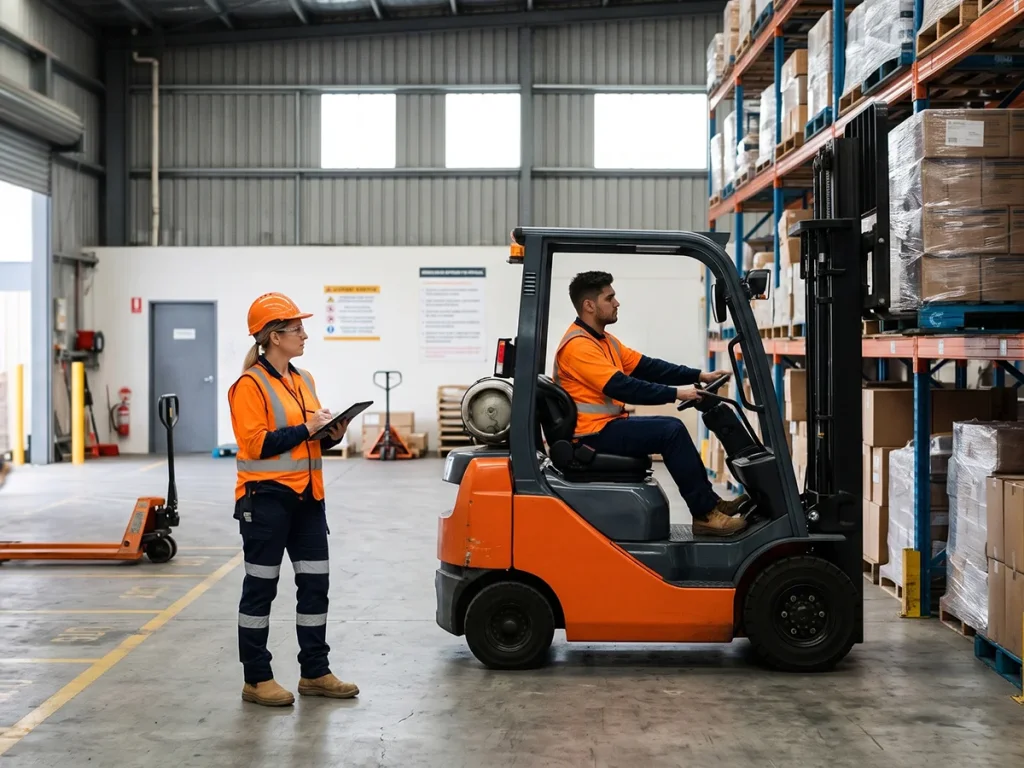
What does a new starter actually do on their first day in a warehouse? An entry-level warehouse operator’s responsibilities include storing and packing goods, handling receiving paperwork, retrieving stock, and doing periodic stock checks.
Along the way come the shift loadings for early, afternoon, and night work, plus specialist licences and certificates that open more and more doors. Warehouse operations career progression is clear and achievable for many in Australia.
If you want to boost your transport and logistics career and progress from a warehouse operator to a manager, stick with us.
What Does a Warehouse Operations Career Involve?
Warehouse operations cover receiving, storing, picking, packing, and despatching goods. A warehouse operations career starts with those floor tasks and moves through supervisory positions to management roles, with the award’s grades giving clear progression pathways.
The primary duties and daily operations of a storeperson or warehouse operator include:
- Receiving goods
- Checking for damage and invoice discrepancies
- Unloading vehicles
- Labelling goods with storage locations
- Packing, weighing, and sealing
- Using computers to find stock location and quantity
- Operating order pickers
- Checking goods off picking lists
- Taking stock of inventory
- Driving forklifts
Jobs and Skills Australia counts 166,600 storepersons in the Australian Bureau of Statistics (ABS) Labour Force Survey. Most warehouse staff are full-time, and employment in the occupation is growing by 2,400 a year.
What are the Entry-Level Warehouse Jobs?
Entry-level warehouse jobs carry several titles, and none of them requires a degree. The titles you will see include storeperson, storeworker, order picker, forklift driver, warehouse operator, and freight handler.
Entry-level positions involve equipment operation from the start, from hand trucks and pallet lifters to order pickers. The tasks call for attention to detail, such as checking goods against invoices, and physical work, such as unloading vehicles and lifting goods into place.
To drive a forklift for warehouse operations, you need a high-risk work licence. You can get a forklift licence as an LF forklift or LO (order-picking forklift) licence class. You must be 18 or older, and the licence is valid for five years.
Training is optional at this stage. Major lists the Certificate II in Supply Chain Operations as an entry-level course, and the Certificate III has no formal entry requirements and names warehouse operator and freight handler among its roles.
How Much Do Warehouse Employees Earn?
Warehouse employees on the Storage Services and Wholesale Award earn a minimum of $27.08 an hour. That’s the Grade 1 rate for a full-time adult, as per the Fair Work Commission’s consolidated award. The table shows the minimum under each storeworker grade.
| Storeworker grade | What the grade involves | Minimum weekly pay | Minimum hourly pay |
|---|---|---|---|
| Grade 1, on commencement | New employee using non-licensed equipment | $1,029.10 | $27.08 |
| Grade 1, after 12 months | Same duties with a year of experience | $1,053.50 | $27.72 |
| Grade 2 | Licensed operation of materials handling equipment | $1,062.80 | $27.97 |
| Grade 3 | Quality control, store layout, supervising up to 10 employees | $1,093.10 | $28.77 |
| Grade 4 | Running a warehouse or large section, leading hand for more than 10 | $1,125.30 | $29.61 |
These are minimums for ordinary working hours of up to 38 a week, and employers can pay more. Advertised pay often sits higher than these averages. Many job ads regularly offer full-time salary ranges averaging $65,000 to $75,000 for storepersons and $90,000 to $110,000 for warehouse managers.
Do Forklift Operators and Shift Workers Earn More?
A forklift licence lines up with grade 2 pay. The award says grade 2 covers the licensed operation of all appropriate materials handling equipment, and the minimum moves from $1,029.10 a week for a new grade 1 starter to $1,062.80 at grade 2.
Shift work adds loadings, which work like penalty rates: extra percentages of the minimum hourly rate for working outside standard day hours. Clause 20 of the award sets three.
- Early morning shift: starts between 2.00 am and 7.00 am, paid at 112.5%.
- Afternoon shift: finishes after 6.00 pm and at or before midnight, paid at 115%.
- Night shift: finishes after midnight and at or before 8.30 am, paid at 130%.
Rosters must be set at least 48 hours in advance. Day shift employees can’t be required to work afternoon shift without their agreement.
How Do You Move Up to Warehouse Supervisor or Operations Manager?
Grade 3 is where supervising starts, and grade 4 is where running a warehouse starts. At grade 3 you are responsible for quality control standards and the store layout, and you start managing employees, up to 10 of them. The award expects advanced interpersonal and communication skills at grade 3, and highly developed ones at grade 4.
Grade 4 means responsibility for a warehouse or a large section of one, acting as leading hand for more than 10 storeworkers, and inventory management through control registers and stock movement reports. The award ties grade 4 to skills gained by completing an appropriate warehousing certificate.
Our Certificate IV in Supply Chain Operations is aimed at supervisory roles. Its listed roles include distribution centre supervisor, load/unload supervisor, dispatch supervisor, inventory controller, and facility manager. Major’s career pathway page calls warehouse supervisor a natural progression after working in a warehouse, and Career Start funding covers Major’s Certificate III, while the Certificate IV sits under Career Boost.
Manager level comes last, and these are roles like supply, distribution, and procurement managers. Median full-time weekly pay figures are around $2,834 (as per ABS) for people who plan, organise, direct, and coordinate supply, storage, and distribution.
Start Moving Up in Warehouse Work With Major
We run training courses for warehouse workers across Queensland and northern NSW. Our short courses, such as the forklift licence (TLILIC0003), teach valuable warehouse and supply chain management skills like loading and unloading goods, manual handling, and Chain of Responsibility.
Our advisors can also talk through RPL, credit transfer, and the Certificate II, III, and IV in Supply Chain Operations, so each step fits the grade you are aiming for.
Call us on 1300 790 822 and ask which grade you could reach next.
Warehouse Jobs FAQs
What is the lowest position in a warehouse?
The lowest grade in the award is storeworker grade 1, where the point of entry is a new employee using non-licensed material handling equipment. From 2026, the minimum is $1,029.10 a week on commencement, then $1,041.60 after 3 months and $1,053.50 after 12 months.
Is warehouse work a good career?
Pay is the honest trade-off. Data from JSA in May 2025 puts the storeperson median at $1,328 a week, below the all-occupations median of $1,852. Grades, licences, shift loadings, and supervisor roles give room for career growth, and storeperson employment is growing by 2,400 a year.
Which job titles should you use in a job search?
Search for storeperson, storeworker, order picker, forklift driver, and warehouse operator, which appear in the JSA task lists, the award, and our Certificate III roles. For supervisor roles, try distribution centre supervisor, which is about the level of a Cert 4 qualification.
What breaks do warehouse workers get?
Under clause 14 of the award, nobody works more than 5 hours without a meal break of 30 to 60 minutes. Employees also get paid 10-minute rest breaks in the morning and afternoon.

Ready to Get Licensed?
Get supply chain training today to advance your career. Start with a forklift licence, and you’ll be well on your way to becoming a warehouse manager.