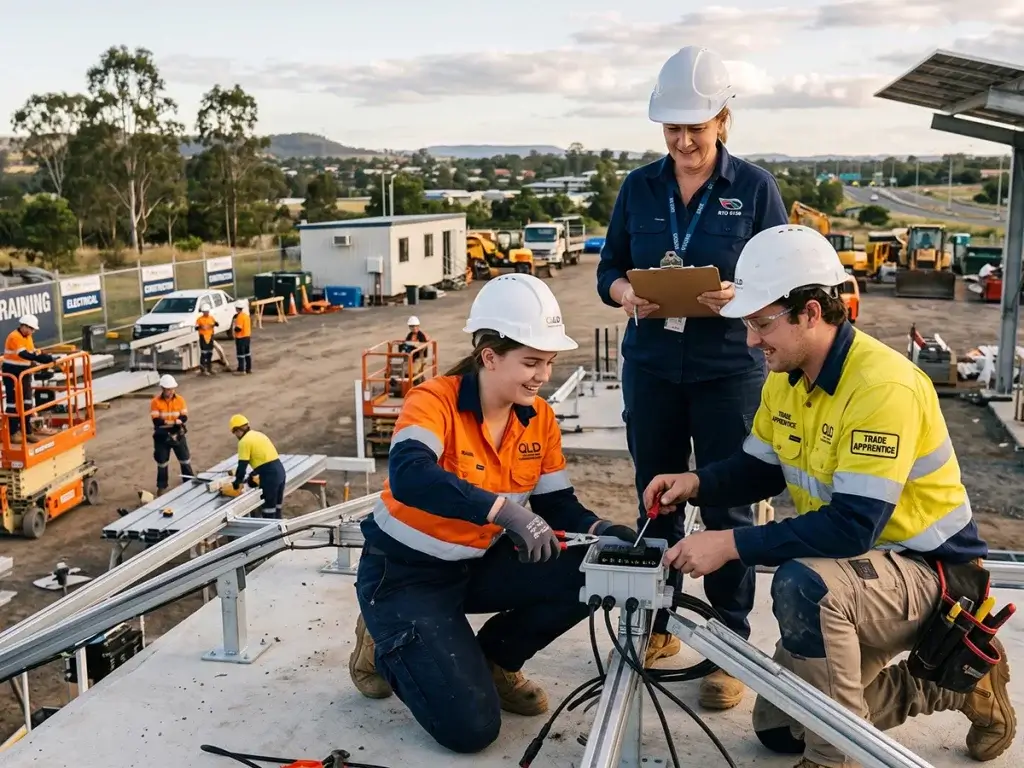
The Building and Construction General On-site Award 2020 (also known as the construction industry award) is a series of regulations that sets the minimum pay, allowances, and hours for anyone working on a Queensland building, civil, or engineering construction site.
It’s important for all employers to get the base requirements and rates right to avoid underpaying staff and prevent compliance issues. This guide explains everything that Queensland employers need to know.
Who is the Construction Industry Award for?
The award does not cover employees already under the Electrical, Plumbing, Joinery, Manufacturing, Mining, or Pre-Mixed Concrete Awards, but it does cover labour hire businesses and the workers they place on a construction site.
Civil construction work
The award covers three sectors of work performed on site: general building and construction, civil construction, and metal and engineering construction.
Civil construction covers roads, bridges, tunnels, and drainage, while engineering construction covers on-site metal trades work at power stations, refineries, and transmission structures.
Construction Award Pay Rates From 1 July 2026
The current rates took effect in the first full pay period from 1 July 2026. Every figure below is a minimum rather than a going rate.
Across twelve classification levels, a Level 3 construction worker, the trade-qualified rate, is on $1,119.10 a week or $29.45 an hour. Level 1 starts at $1,013.50, and a Level 9 engineering construction worker tops the ladder at $1,309.50.
Level 3 matters most. The award calls it the standard rate, and every apprentice percentage comes off it.
The National Minimum Wage is $26.44 an hour, but it only applies where no award or enterprise agreement covers the employee.
Fair Work Ombudsman pay guide
Fair Work publishes a pay guide and a pay calculator for this award. Check them each July, because rates move with the annual wage review.
Ordinary Hours and RDOs Under the Award
Ordinary hours set the baseline that every penalty and allowance builds on, and RDOs are how a 38-hour week gets banked into four-week cycles.
Full-time ordinary hours
Full-time ordinary hours are 38 a week, averaged over a 20-day four-week cycle so rostered days off accrue. They fall between 7.00 am and 6.00 pm, Monday to Friday, with no more than eight in one day.
Work a rostered RDO and they are paid Saturday penalty rates, and still keep the accrued day.
Higher duties
An employee put on higher-rate duties for more than two hours in a day must be paid the higher rate for the whole day. Under two hours, you pay only for the time at that classification.
Daily Fares and the Other Allowances On-Site
The award layers expense-related allowances on top of the classification rate, and two reach almost everyone on site.
The industry allowance
Employees in building, civil construction, or metal and engineering construction are owed an industry allowance of $67.15 a week, and residential work on single or dual occupancy homes attracts $53.72 instead.
It is paid for all purposes, a phrase that matters more than it looks.
Tool allowances by trade
The tool allowance depends on the trade, and is also paid for all purposes:
- Carpenter or joiner: $41.22 a week
- Plasterer: $34.10 a week
- Bricklayer: $29.26 a week
- Roof tiler or metal and engineering construction tradesperson: $21.59 a week
- Signwriter, painter, or glazier: $9.89 a week
- Air conditioning or refrigeration industry allowance: up to $88.41 a week
- Electrician’s licence allowance: $35.81 a week, for all purposes
Daily fares and travel
The fares and travel pattern allowance is $22.41 for each day worked where the employee starts and finishes on a construction site. It is a daily fares payment, not a reimbursement, so no receipts come into it.
It also has an off switch, because you do not owe it on any day you provide free transport home to site, or a fully maintained vehicle.
Travel between sites in ordinary hours draws ordinary time pay, and you owe $1.00 per kilometre where the employee drives their own vehicle. An underground allowance of $20.14 a week applies where the work demands it, and payslips must show each allowance separately.
Overtime and Shift Penalties Run on a Different Number
Here is what catches employers out: the classification table gives minimum classification rates only.
Penalties build on the ordinary hourly rate, which the award defines as that classification rate plus the industry allowance and any other all-purpose allowance.
The allowances are not paid on top of the wage. They become part of the base figure that every overtime and penalty rate multiplies.
- Overtime, Monday to Saturday: 150% for the first two hours, 200% after
- Saturday after 12 noon: 200%
- Sunday: 200%, for every employee, not shift workers alone
- Public holidays: 250%
- Afternoon, night, or early morning shift loading: 150%
- Morning or early afternoon shift loading: 125%
- Shift length: eight hours including meal breaks, fixed once rostered
- Casual loading: 25% on ordinary hours, or 225% total where a 200% penalty applies, not stacked
- Annual leave loading: 17.5%
Inclement weather belongs to construction alone. Lost ordinary hours are paid at the ordinary hourly rate, capped at 32 hours in any four-week period. Someone starting mid-cycle is credited 32 hours in the first week, 24 in the second week, 16 in the third week, and 8 in the fourth.
What You Owe an Apprentice
Apprentice minimums are a percentage of the standard rate, the Level 3 figure of $1,119.10 a week.
On a four-year apprenticeship, Stage 1 pays 50% of the standard rate without a Year 12 completion, or 55% with one. That five-point gap holds at Stage 2, at 60% and 65%.
Both figures converge from Stage 3: 75%, then 90% at Stage 4. A three-year apprenticeship skips straight to that converged path, at 55%, 75%, then 90%.
Stages advance based on competency or time, whichever comes first, at 25%, 50%, or 75% of the training plan competencies, or 12 months into the previous stage.
Now the part that gets missed. The percentage discounts the base rate only. An apprentice is paid the full tool allowance and the full industry allowance as part of their ordinary weekly rate, for all purposes.
A first-stage apprentice carpenter is owed the same $41.22 tool allowance as the tradesperson working next to them.
The QLeave Obligation
QLeave runs portable long service leave for the Queensland building and construction industry, and registering is a legislative requirement if you employ eligible workers here (sole traders and partnership members included).
The obligations are ongoing. You lodge a Worker Service Return each financial year by 31 July, and you tell QLeave whenever a worker starts or finishes. QLeave also runs random inspections of employer books and records.
Workers with ten or more continuous years under one employer may be entitled to long service leave under the Industrial Relations Act 2016 (QLD), and you can claim some or all of that payment back.
Get Your Construction Crew Trained and Compliant
Paying the award right is payroll. Getting the work done safely is a training job.
Major Training runs nationally recognised construction and high-risk work courses across Queensland, covering white card, working at heights, plant operation, dogging and rigging, and civil construction qualifications. Employers can book tailored or on-site delivery, and apprentices train at Yatala, Dinmore, Morayfield, Cairns, or online.
Talk to our team about training your crew.
Frequently Asked Questions
Which construction award applies to my business?
Start with the work, not the job title. On-site building, civil, and engineering construction sits here unless a trade-specific award covers it.
When must construction wages be paid?
By the end of ordinary hours on Thursday each working week. Keep an employee waiting more than 15 minutes past knock-off on pay day, for reasons within your control, and overtime rates apply to the wait.
Is the Building and Construction Award different in Queensland?
No. It is federal and applies the same way in every state. What changes is what sits alongside it, chiefly QLeave, and the award’s electrician’s licence allowance, which names the Queensland licences that qualify.

Need Your Crew Ticketed for the Next Job?
Major Training delivers nationally recognised construction and high-risk work training across Queensland, with group bookings and on-site delivery built around your schedule.